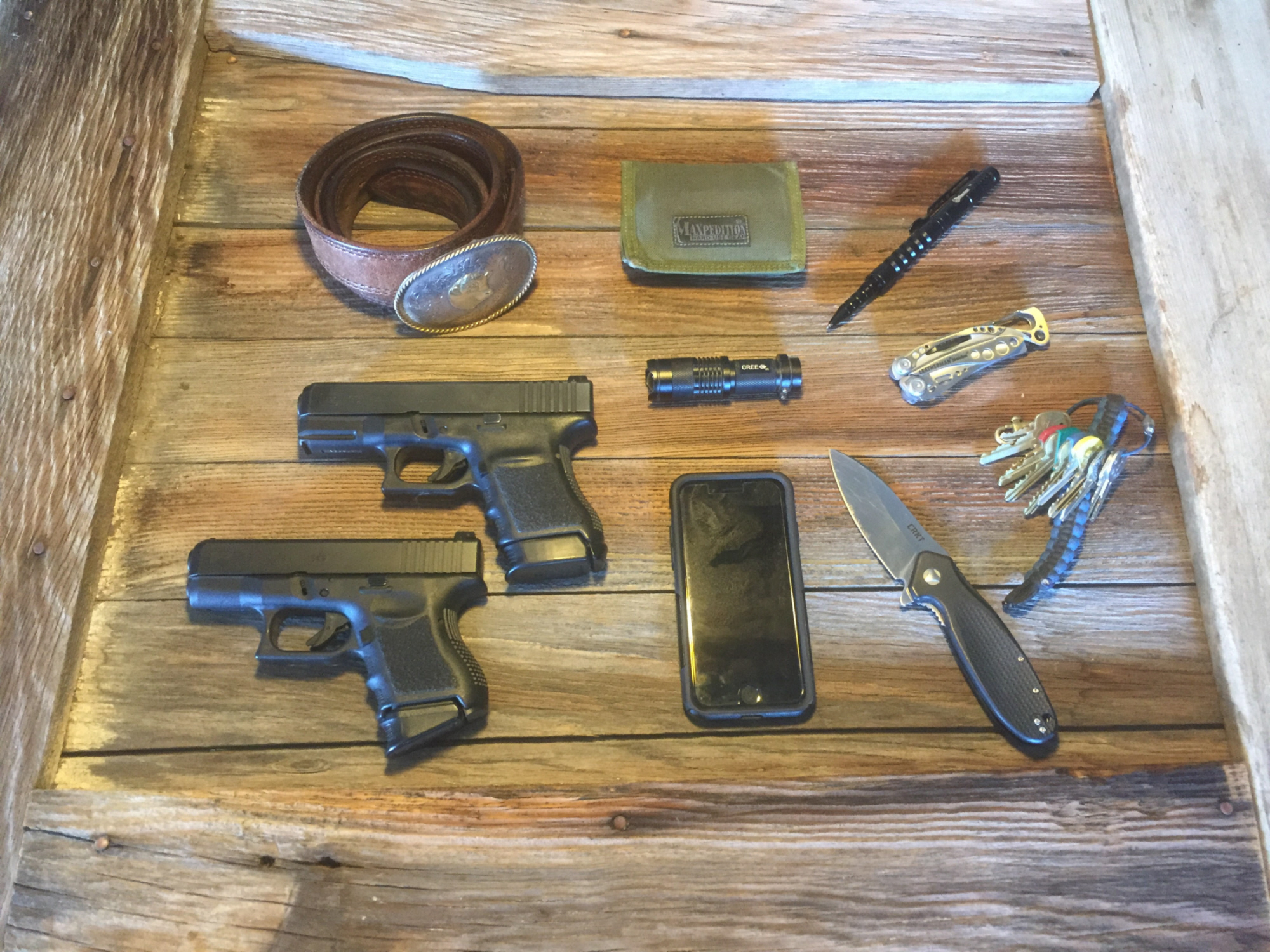
My New Trail Handgun

I do not live in Alaska nor do I hunt or fish there, so why would I need a trail gun?.  My home is Colorado and therefore I would usually hunt, fish, hike, or camp in the back county of Colorado. The likelihood of coming in contact with a ferocious grizzly bear here in Colorado is very slim so I do not need to carry a .44 magnum, .454 Casull, or .500 S & W magnum when I go in the outdoors.  But I like to carry a handgun with me wherever I go so the outdoors is no exception. A person never knows what or who they will come in contact with and what type of force will be needed to fix the issue.

Is There A Need For A Handgun In The Outdoors?

There are people who feel there is no need to carry a firearm with you anywhere and that includes the outdoors.  I saw a post on Facebook from a very good holster company and they were advertising some of their holsters.  There was a comment left by someone who was ranting that there was NO need to carry a handgun in the outdoors and you must be a real pansy if you did (the language was more explicit, but you get the idea). Well everyone is entitled to their own opinion, that’s why we live in America.  But I do not agree with that individual, I would rather have a handgun and not need it than need it and not have it because I was too worried about some idiot’s opinion!.

Would You Want A Small Caliber Or A Large Caliber Handgun?

We first need to distinguish between small, medium, and large calibers. When I think of small-calibers, I think of .22LR, .22 magnum, .25 ACP, .32 ACP, and .380 ACP.  Medium calibers would be .38 Special, 9mm, .40 S&W, and .45ACP. And then large calibers would be  10mm, .357 mag, .44 mag, .454 Casull, and .500 S&W.  There may be some disagreements with my breakdown and I am open to further discussion.

So then what should you carry? That question is for each person to decide, what works for them.  My thoughts are a  small caliber is better than nothing at all, but a large caliber is better and gives you more protection.   

What Is My Handgun Preference In The Back Country

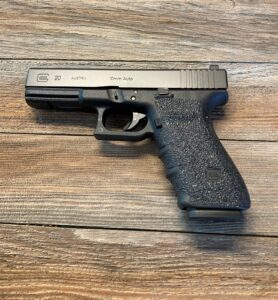
As I said earlier, I do not feel I would run into a Grizzly Bear in Colorado so one of the heavy magnum revolvers would not be necessary.  My caliber of choice is the 10mm when loaded correctly it has a lot of knockdown power that will give you what you need in a trail gun.  There are quite a few good handgun manufacturers out there that make the 10 mm, and the decision was a bit difficult. I have chosen the Glock 20, it is the full-size version with a 4.61-inch barrel that holds 15 rounds plus one in the chamber.  They have a Glock 29 which is one of their subcompacts with a 3.78″ barrel and it holds 10 bullets in the magazine and one in the chamber.  While it is also a great handgun, I like the full-size handgun with more rounds in the magazine. Some people insist on carrying a 44-magnum revolver with 5 or 6 bullets in the cylinder.  They are more powerful then than a 10mm but I like having 15 bullets instead of 6 in my trail gun. Plus I can shoot a 10 mm better than I can a 44 mag and that is more important to me. A well-placed 10 mm round means more to me than a shot from a 44 mag that is not where I wanted it to go.
What Kind Of Ammo Would I Carry In It?

There are many different handgun calibers to choose from but as I mentioned, I like the 10mm as it is one of the most powerful semi-automatics available and I like the idea of having more rounds in my magazine instead of just 5 or 6 from a revolver.  If I carry an extra magazine, that gives me 30 rounds of 10mm ammo if I need it.

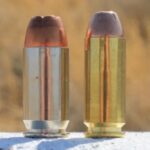
Before the 10mm, I used a 45 ACP (45 ACP on the left and 10mm on the right), while it is a great self-defense caliber and greater diameter bullet, it is fairly slow-moving and does not have enough energy to cause great damage to a predator if you need to use it.  With the correct ammunition, a 10mm having a 180 gr bullet would go 1350 fps and have 728 ft. lbs. compared to a 230 gr 45 ACP bullet would have 830 fps with 455 ft. lbs of energy.  If you were in a situation where you needed protection from a predator the 10mm would give you better odds.
How Would I Carry My Trail Gun?

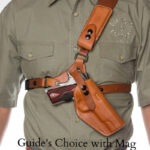
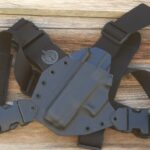
There are many types of holsters available on the market today. Outside the waistband, inside the waistband, appendix, shoulder holster, and chest holster, to name a few.  When I am hiking, biking, horseback riding, backpacking, hunting, or fishing, many of those above-mentioned holsters will not work.  If you are being very active or wearing a backpack there is only one type of holster, in my opinion, that I see working in these situations, it’s the chest holster.  The chest holster is a holster that is mounted on your chest, held there by a harness system that secures your handgun very well.  There are many different manufacturers of a chest holster but there are two that I would stand by, Gunfighters, INC, and Diamond D Leather.  Gunfighters.INC makes a Kydex chest holster named Kenai Chest Holster (upper picture) and Diamond D Leather makes a leather chest holster named the Guides Choice Holster (bottom picture). They both are fantastic!  I was told once that if you had a polymer handgun go with Kydex and if you had a stainless steel handgun, go with leather. I am partial to Kydex and therefore the Kenai Chest Holster gets my vote.  They are a bit pricy but well worth it.  They fit your handgun perfectly and are extremely secure.  They are an all-weather holster that works over the top of your jacket or just under an outer shell.  They have an extra magazine holder on the harness strap which is easy to get to.  These holsters are ideal if you wear a backpack while in the outdoors.  Just put on the holster and then put on your backpack and off you go.  When it is time to rest you can remove your backpack and keep your handgun on your body.  If you need your firearm they a very fast to get to and so very comfortable as your shoulders take all the weight of your handgun.

Down The Trail We Go

In this article, you found out why I carry a handgun in the outdoors, that I like to carry a Glock 20 (10mm) as my trail gun.  And that my holster of choice in the outdoors is the Gunfighters, INC Kenai Chest Holster.  I hope this article helps you to think about this subject matter and gives you the opportunity to form your own opinion on this subject.  I would welcome any thoughts or comments about this subject and whether you agree or disagree with me.  So until then, get outside, enjoy the outdoors, be safe, and be aware of your surroundings.

If you have any questions about this post or anything related to Everyday Carry (EDC), feel free to leave a comment below and I will be happy to get back to you.

All the best,

Larry

Founder of EDC Essentials

    LEAVE A REPLY

    Your email address will not be published
    Required fields are indicated

    Does Getting Older Affect The Way We Carry Our Handguns?

    I have been carrying concealed for about 25 years and I have tried many different holsters during that time. No matter which holsters I have tried my overall favorite has been IWB.  Is it the most comfortable? No! But it seems to be the most functional.  But as I get older that comfort level seems to decrease, so what now?

    What are some of the issues that occur when you are getting older?

    I am not sure about everyone else but for me, my body seems to be wearing out.  I just turned 70 years old and issues are starting to show up.

    My first issue has been with my rotator cuff, which mean less flexibility and decreased range of motion.  This does affect what works best for me at this time in my life.  

    I also have a detached bicep – they say this is due to decreased rotator cuff function which puts more strain on my biceps. This has not affected my range of motion yet but it does affect my strength.  So I cannot do everything I used to be able to do.  This issue does not affect my carrying concealed at the present time but it may in the future.

    Arthritis is also something that may limit my ability to carry concealed. Not so much right now but as time goes on it may be a big issue. My knees and hips are affected mostly right now.  My hands, fingers, and arms do not seem to be affected yet and that’s a good thing.

    Don’t get me wrong, I am not one of those individuals that sits on the couch and watches TV all day and then goes to bed. I work a full-time job and a second part-time job, then have a small farm with cattle, goats, horses, ducks, and chickens to care for when I get home. So I am a very active guy for my age, with many things to do. But as the years go on, my body just seems to be telling me that some changes are going to be necessary. Someone said that getting old is not for sissies and I highly agree.

    How Will These Issues Affect Carrying a Handgun?

    Since it seems like the above mentioned conditions are changing slowly in my case, certain things about carrying concealed will also happen slowly. Let’s just say some concealed carry methods that were once used may not be the ones that work now. The predominant reason things change is comfort and range of motion, these issues or conditions bring about changes to your body that just makes it uncomfortable to carry a handgun in the same manner that you used to or your range of motion begins to restrict the things that you used to be able to do but cannot anymore..

    Changes to your carry methods

    As much as I have carried my handguns in IWB holsters for most of my life, I am not enjoying it as much anymore.  I find myself using my OWB holster a little more and it works very well. I love my chest holster but that does not work very well as concealed carry option.  A while back I purchased a Spectre Shoulder Holster from Gunfighters, Inc.  It seems to be easier to carry a handgun under my arm then in my waist band.  I am also enjoying using pocket carry to carry concealed. This method works great with a pocket pistol (.380 ACP) and a good Kydex pocket holster. The only thing is it does not work very well with jeans, you need to wear pants with slant pockets so you can get your hand in and out quickly.

    Changes to your potential handgun

    I have mentioned the discomfort I have been feeling with my IWB holster and my .45 ACP.  Now That I am using my OWB holster and shoulder holster more I am finding out that a lighter and smaller handgun works a little better for me these days.  So that means going from a Glock 30 (.45 ACP) to a Glock 19 (9mm)  is a logical move.  Plus pocket carry is also very workable, with the Ruger LCP Max (.380 ACP), nice choice with more firepower. Lighter weight and a smaller package does work well.

    Final Comments

    As I get older my body is going through some negative changes and that means I need to make some adjustments as I continue to carry a handgun concealed.  Changing my primary handgun to a lighter and smaller one is the best place to start.  Finding one I can shoot well and that feels great in my hand will definitely make a difference.  Making some holster changes will also make things better.  Being aware that your body changes and then adapting to those changes is something that is needed as you age.  As long as you know this stuff is coming your way you can make the necessary adjustments. 

    If you have any questions about this post or anything related to Everyday Carry (EDC)/Concealed Carry, feel free to leave a comment below and I will be happy to get back to you.

    All the best,

    Larry

    Founder of Everyday Carry Essentials

      LEAVE A REPLY

      Your email address will not be published
      Required fields are indicated

      Cleaning Your Guns Using A Rod Or Cable?

      We all know the importance of cleaning your guns, but what method is the best?  Do you do it the way your Dad or Grandfather taught you? Were you given a gun cleaning kit with your first gun and that’s what you stuck with?  Did a friend tell you which type to use? Or did you explore the Internet for the all time best method of cleaning your guns and that’s what you use?  These are all good ways to find out information but let’s explore this question then you can be the judge.

      Rod Cleaning Systems?

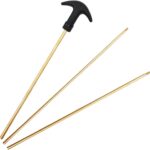
      Many people swear that the only way to clean a gun is by using a cleaning rod.  When I was young that was the only way to clean your gun so we did not question these rods. Cleaning rods do work great and now they are usually in the form of a one-piece coated rod or rods that screw together in sections to form a long cleaning rod. Whether they are one-piece or in sections they do a similar job in the end.  A one piece rod is usually Teflon coated so it does not scratch the crown or the barrel. The cleaning rods that are in sections are usually made out of brass or aluminum and will not usually scratch your barrel.  But it is a good idea to use a bore guide (protector) to protect your barrel crown when using these metal cleaning rods. You place them in the end of your barrel and then slip the cleaning rod inside the bore guide and into the barrel, this keeps the rod centered in the barrel and not scraping the barrel or crown of your gun. Cleaning rods can do a fine job as long as you are careful when using them.
      Cable Cleaning Systems?

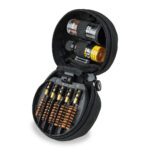
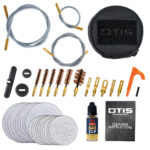
      Some years ago gun cleaning cables were developed, this was something new that many people have not seen before. There are a few companies that produce these gun cleaning systems but my favorite is from OTIS Technology.  They make high quality gun cleaning kits with excellent customer service to back it up. They produce every kind of gun cleaning kits that you might want, my favorite is the OTIS Tactical Gun Cleaning kit for rifles, shotguns and handguns. It has everything you would want to clean your guns and do a very thorough job I might add.  An advantage to the cable system is that you do not have to teardown your gun so that you can clean from breech to muzzle. Because the cable is flexible you can just open up the action and put your cable end into the breech and slide it down the barrel to the muzzle. A pretty cool way to clean your gun.
      Supplies Needed?

      No matter if you use a rod or a cable to clean your guns, there are certain things that you will need with both systems. They both need brass jags, brass brushes, cleaning patches, scrubbing brushes, cleaning solvent and/or CLP solution, wipe down rags, and shotgun swabs if you are cleaning shotguns.

      Many people these days use one product for cleaning, lubricating and preserving (a CLP). There are many of them on the market to choose from if you want to go that way. I use Hoppes #9 solvent for cleaning my bore and other very dirty areas, then I use Break-free CLP for lubrication and preserving. This method works very well as long as you make sure the solvent is wiped-out before you add your Break-free. There are many different cleaning product to choose from to clean your guns, this is only what I use.

      Things To Overcome

      My Dad taught me to clean his guns at the age of 10-years-old so naturally his way was the only way to clean them. I suppose you have heard, My way or the highway!  and in those days that was the way it was. Anyway, that method was to use his aluminum rod sections that screwed together to form a longer gun cleaning rod. This method worked and worked really well for 59 years of my life. If you were a “Cleaning Rod Guy” like I was, you would have a difficult time thinking that a cleaning cable can do as good of a job as a cleaning rod can do.  

      So when I was introduced to OTIS Technologies Cable System in some YouTube videos, I was very skeptical. But for some reason I kept going back and watching these same videos over and over again and their methods began to make sense to me. So there was “old school” vs “new school” going through my mind and I began to see how cables might have a place in my gun cleaning world.  

      I had two types of rifles growing up, bolt action and lever action rifles and  then one 22LR/mag revolver.  I was always told to clean a rifle from the muzzle to the breech no matter what kind of gun it was, so that worked for me.  As I got a little older I was told by my girlfriend’s father (he was a policeman) that you should always clean your guns from breech to muzzle to keep them cleaner.  So I began to change my cleaning methods from what my Dad taught me as a kid and it made sense.  But this was easy with the bolt action rifles but when I got to my lever action rifles, that was very difficult. With a bolt action rifle you can just remove the bolt and run your rod down the barrel. But a lever action rifle was a bit more tricky to remove the bolt, especially a Winchester 94, which is what I had growing up. It was necessary to take out screws and push out pins to get the bolt out, and that was more difficult. So I just cleaned them from muzzle to breech and it still worked, I just had to be more careful. Then came OTIS Technologies and I found out that I could clean my lever action rifles from the breech to the muzzle very easily. How cool was that!

      The Cleaning Process

      The rod gun cleaning system is the most common gun cleaning system on the market today.  And it is something that has been passed down from generation to generation. This process takes a cleaning rod, copper jags, copper cleaning brush, cleaning patches, cleaning solvent, CLP oil and a wipe down cloth for final cleaning.  1) The first thing to do is unload the rifle and make sure that it is clear before starting to clean your firearm. You must remove your magazine (if equipped) and any ammunition that may be loaded within the firearm including in internal magazines. Make sure you do a thorough visual check, and feel with your finger that there are no bullets in the chamber before you go to the next step. 2). Using a cleaning utility brush or cleaning swabs, remove any excess dirt, etc. from your firearm. Place a copper slotted jag on your cleaning rod and a cleaning patch in the slot. Apply some bore cleaning solvent to the cleaning patch, and run the patch through your barrel and let set for a couple of minutes. Next use a copper brush and run it completely through the barrel to loosen up the fouling in the barrel.. Follow up this with several dry patches to make sure your barrel is clean and dry. Use some swabs to clean hard-to-reach areas and ensure you get your barrel/chamber as clean as possible. 3). Once you’ve completely cleaned your action, bolt, receiver, and barrel, you’ll want to properly oil & lubricate the moving parts of your firearm. Look for worn metal areas on bearing surfaces such as your action, and bolt lugs. On a well-used firearm you’ll see bare metal through the finish in some places.  4). After you’ve cleaned and lubricated your firearm, wipe it down with a clean, dry cloth. This removes residue and oils/moisture from fingerprints that you may have missed in steps two and three. A quick wipe and polish of any wooden furniture on your rifle is also a recommendation. 5). Once everything is cleaned, and wiped down, it’s time to start reassembling your rifle. It is a good idea to carefully inspect each piece as you put it together and make sur there are no problems with the pieces.

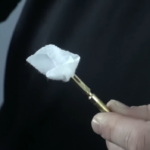
      The cable gun cleaning  system is an easy three-step cleaning process, it is basically similar but takes some different tools.  Before you began cleaning there are a few things that you need to do. First make sure your firearm is unloaded, remove the magazine or bullets and inspect that there are no bullets in the gun. Then inspect the firearm and look for any excess dirt or debris on the outside, if you see any, use a utility brush to clean it off. Next remove the bolt or just open the action on the firearm. 1) Place their slotted end on one end of the cable. put on one of their special round patches in the way as directed, add some bore cleaning solvent or CLP to the patch. place the opposite end of the cable into the barrel on the breech end push it through the barrel until the patch is at the end of the barrel. then draw it through the barrel, from breech to muzzle. 2) Remove slotted-end and put copper brush on the cable and draw through barrel from breech to barrel-end.  Wait for a few minutes to let the chemicals work. 3) Then put the slotted tip back on along with a clean dry patch, as directed and draw the cable through the barrel from breech to muzzle and repeat this step until the patch comes out clean.  End result is a clean gun.
      Final Comments

      So what are your final thoughts,  I think either way works good. Both of these gun cleaning systems will work to clean your guns, it just depends which one you like best.  If you don’t like your gun cleaning method then you won’t clean your gun and that’s not good. My favorite gun cleaning system right now is OTIS Technology cable cleaning systems.  They have so many different gun cleaning kits that you are bound to find one that works for you. But the best thing about these systems is that you can clean your gun without taking it apart. Being able to do that saves time and that means a lot these days. 

      But there is one time that I still use my one piece, Teflon coated cleaning rod and that is if I have a new rifle.  I have adopted a set of specific procedures where you need to clean your gun a certain way before you even fire the gun and for this I only use my one piece cleaning rod.  Then I change to the OTIS System after the rifle is fired.

      So which method is the best? Is there a clear winner? Absolutely not! I think they both have their place in the gun cleaning world. You should use whatever method feels best to you. But don’t take my word for it, check it out yourself, you will be happy that you did.

      If you have any questions about this post or anything related to Everyday Carry (EDC)/Concealed Carry, feel free to leave a comment below and I will be happy to get back to you.

      All the best,

      Larry

      Founder of Everyday Carry Essentials

        LEAVE A REPLY

        Your email address will not be published
        Required fields are indicated

        Would You Ever Buy A Chest Holster?

        A chest holster was something I never thought I would buy, I never saw a need for one. All my holsters have been attached to my belt and that has worked fine for me so far.  But boy was I wrong! The chest holster is the best outdoor holster that you could ever utilize.  

        Pros About A Chest Holster

        The chest holster is a really good holster and here are a few reasons why:

        • Chest holsters do not obstruct your movements,
        • They are an ideal choice for outdoor activities such as biking, backpacking, hunting, climbing, camping, etc.
        • They allow very quick access to your handgun
        • They might work well for concealment, depending on your cover garment
        • They retain your handgun very well
        • The size adjustment work well for most sized people
        • They are very comfortable when adjusted properly
        • They are a good choice for large pistols and revolvers

        Cons About Chest Holsters

        The chest holster has a few things that you must be aware of:

        • They may not be the most ideal holster for concealed carry
        • Not everyone likes the way they fit
        • They may not be the best choice for people with back or shoulder issues

        Most Popular Chest Holsters

        There are quite a few manufacturers that make a chest holster, here are my five favorites:

        • Gunfighters, Inc – Kenai Chest Holster, best Kydex holster
        • Diamond D – Guides Choice Chest Holster, most versatile chest holster
        • Galco – Kodiak Shoulder Holster, best revolver chest holster
        • Mans Gear Alaska – Chest Holster, Best nylon chest holster
        • Hill People Gear – Kit Bag, Most versatile nylon chest holster

        Which Chest Holster Did I Buy?

        If you have read many of my posts you will know I like Kydex holsters, so why should that be any different with a chest holster.  My favorite chest holster is the one from Gunfighters, Inc, their Kenai Chest Holster.  This holster is designed to go over the top of your vest, jacket or other outer garment. so once you get it adjusted, it fits like a glove. Unlike a shoulder holster you should not  trim the excess straps to fit because depending on the season and your layers under the harness may change. The holster holds your handgun very securely and is in a position that you can get to it very easily. This is a holster that works well in most all outdoor activities, I use it when hiking, backpacking, fishing, hunting, horseback riding, 4-wheeler riding, farm chores to name a few.  

        Final Comments

        I really like this holster, it is very comfortable, versatile and keeps your handgun in a place that is easy to get to.  I use this holster with my Glock 30 (.45ACP) and Glock 20 (10mm), and the nice thing is all you need to do is buy a new shell for each caliber handgun, one harness will work with all the different shells. My favorite use for this holster is backpacking, You just put on this chest holster and then put on your backpack and you are ready to go. When you get to a resting place just remove your backpack and your handgun stays where it needs to be.  I always had a difficult time figuring out where to put my handgun when backpacking and then being able to get to it when you needed to or taking off your backpack and off came your handgun too. Another plus about this chest holster is that it is basically weather-proof too, unlike the leather chest holsters that are on the market.
        If you are looking for an awesome chest holster that feels comfortable, and holds your handgun very securely check out the Kenai Chest Holster from Gunfighters, Inc. I like this Kydex chest holster and recommend it fully. 

        If you have any questions about this post or anything related to Everyday Carry (EDC)/Concealed Carry, feel free to leave a comment below and I will be happy to get back to you.

        All the best,

        Larry

        Founder of Everyday Carry Essentials

          LEAVE A REPLY

          Your email address will not be published
          Required fields are indicated

          What Is Your EDC Knife, a Folder or a Fixed-Blade?

          Choosing your EDC knife comes down to a personal choice.  Which one do you like best? Which one do you feel is more functional? Which one is cooler? What is the use for the knife?  And which one fits your lifestyle better? These questions are necessary to answer to figure out your choice.  But everyone knows that we should all carry a folding knife, or should we?
          Let’s Talk Knives

          There are so many knives on the market today, and the price range is from inexpensive to mega bucks. When I was younger it used to be an easy choice when purchasing a knife, if you wanted a pocket knife there was one standard style, a small multi-blade knife that would fit in your pocket.  There were no belt clips, no belt holsters just a small knife.  Then if you wanted a fixed-blade knife you had to carry a large knife on your belt.  But those easy choices are over now, there are so many choices in todays knife market and your decision gets more and more difficult.

          Uses Of A Knife

          Is this going to be an Everyday Carry (EDC) knife or will it be for a specilized purpose?  If it will be used for opening boxes or packages, cutting string, twine, or rope, carving wood,  then I would consider it a EDC knife.  If you will be carving meat, personal protection, hunting or fishing, cutting seatbelts, breaking a window or other emergency uses, that would be a special knife.

          Folding Knife Advantages.

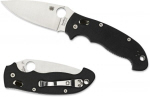
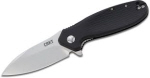
          A folding knife seems to be the most popular knife out there.  It is safe, easy to conceal, and can be in a small package and placed in your pocket.  For many years they have been known as pocket knives.  It is easy to get in and out of your pocket for daily tasks and does not usually get in the way. Some of the folding knives have a locking mechanism which keeps it open until you wish to close it.
          Things To Think About When Using A Folder.

          A folding knife is generally not as durable as a fixed blade knife.  Since the knife has a hinge, it can bend or break when you least expect it to. One thing to remember is that folding knives are harder to clean. and if used very aggressively can occationally break.

          There are two types of locking mechanisms to consider: a “lockback” style folder is a very secure mechanism but does require two-handed closing.  The “liner lock” knife allows the user to close the knife with one hand.

          Fixed-blade Knife Advantages.

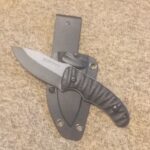
          A fixed-blade knife is much stronger and ridged since it is made out of a solid piece of steel, they can be used rougher and work stronger than a folder.  They are more durable and hold up to the elements well because they do not have a folding mechanism as with a folding knife.  A fixed-blade knife is easier to clean and maintain and can be deployed faster in a self defense situation.
          Things to think about with a fixed-blade knife.

          The biggest downside to a fixed blade knife is they are harder to conceal and not as convenient to carry. But with the right style of sheath they can work very well.

          Final Comments.

          After reading all of this information, the biggest choice comes down to you and what you like.  With all the various knive available on the market you can fine one that suites you and how you plan to use that knife.  The other good thing is that you do not have to only choose one knife, you can have as many styles of knives that you desire for whatever  activity that you are doing. Enjoy your knife hunting!

          If you have any questions about this post or anything related to Everyday Carry (EDC)/Concealed Carry, feel free to leave a comment below and I will be happy to get back to you.

          All the best,

          Larry

          Founder of Everyday Carry Essentials

            LEAVE A REPLY

            Your email address will not be published
            Required fields are indicated

            Trimming the Forend Grip on a Mossberg 500 Field Model and Installing an Esstac Shotgun Card

            I have a Mossberg 500 field/security combo, which means it comes with two barrels, a  28″ hunting barrel, an 18.5″ self-defense barrel, and a pistol grip.

            It’s a great shotgun combination that works very well but there is a small modification that would make it even better.  I am making this change so that I can carry some additional shotgun shells on my shotgun receiver for either hunting or home defense. This article may seem a little out of place on this EDC/Concealed Carry website but it is definitely related.  

            Why Trim The Forend Grip?

            So the initial pandemic is over and things are getting back to normal.  Guns and ammo are beginning to return to the shelves at gun stores and that is a good thing if you are a gun enthusiast.  But what about parts for your guns?  I have been waiting for a new Mossberg forend slide assembly to become available so I can replace it on my shotgun and they are all on backorder.  No matter where I look online they are not available.  The reason I want a new assembly is so I can buy a different forend grip that will accommodate a 6-shot side saddle on my shotgun.  Unfortunately, the style forend that I have will not let me do this, it has small wings that overlap the receiver making it impossible to have a 6 or 7-shot card in place. I can only put on a 4-shot side saddle on my receiver and that limits my extra shotgun shells capacity.
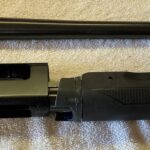
            If I cannot buy a new action slide assembly then the only other thing to do is trim the rear portion of my forend grip to remove the wings so it will not overlap with the receiver and hit the side saddle.  I looked on YouTube for videos that explained this procedure but I could not find anything on that subject, so I had to use my best judgment in doing this project on my own.

            Getting The Forend Grip Off Of The Shotgun

            I looked at many videos on Youtube to understand how to remove the forend from the shotgun. Removing the forend grip is not difficult but does require a few steps.

            • The first thing to do is make sure the shotgun is unloaded and move any loose ammunition away from your work area and to a secure location.
            • Loosen the gun barrel nut until it is free from the end of the magazine and pull the barrel off, and set it aside.
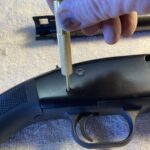
            • Push out the pin just above the trigger and place it in a dish or safe container so it does not get lost.  
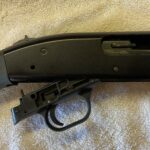
            • Pull the trigger assembly down and forward from the receiver and set it aside.
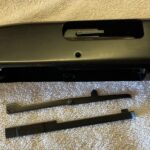
            • When the trigger assembly is removed, two rails will become loose and they need to be set aside too.
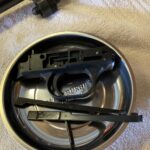
            • Place all the parts in a container so they will not get lost.
            • Lastly, align the tabs on the slide with the cuts in the receiver and pull out the bolt assembly, and set that aside as well.


            • At this point, you can pull the forend grip out of the receiver and off of the magazine tube.
            OK, The Forend Grip Is Off Of The  Shotgun, Now What?

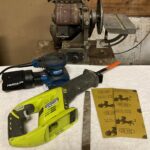
            In order to trim this forend grip, I used a reciprocating saw, bench disc sander, a single-cut file, an orbital sander, and some sheets of 100, 150 & 220 grit sandpaper, as seen in the picture. My first choice would have been a bandsaw, but mine is out of commission right now.
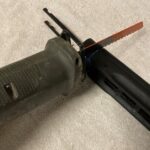
            I used blue painter’s tape to mark where I wanted to cut.  I used painter’s tape because it does not leave tape residue. Normally a sharpie would work to mark my cuts but they are difficult to see on the black surface.

            When I used my reciprocating saw I had a metal cutting blade in it so the cut would be very smooth. As I cut the synthetic forend grip I cut very slowly so I could keep control of the saw so it would not over-cut the grip.
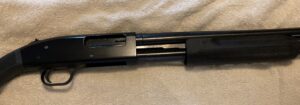
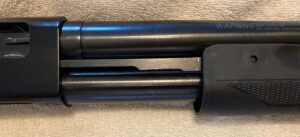
            When I finished cutting I lightly touched up my cuts on the bench sander (100 grit), followed by the single-cut file, then with the orbital sander (150 grit).  Finally, I used some  220 grit sandpaper by hand to finish the job.  Each of those steps got my sawed edges smoother and more contoured. The last thing I did was take some gun oil on a cloth and buffed the edges.  This turned the whitish edges a darker black. At that point, I removed all the paper and blue painter’s tape and my finished product looked like this.

            Then of course I had to put the forend back on my shotgun and got it back to working order, here is the completed job.

            What Are The Advantages To Trimming The Forend Grip?

            My first choice would have been to purchase a new action slide assembly so I could have selected a new forend grip of my choice, as there are many good ones on the market.  But since they were not available right now I thought this was the very best thing to do so I can set up my shotgun as I desire.  This alternative will work for now and if in the future I really feel a need to get a new forend grip, I can go that route.

            Was Trimming The Forend Slide Worth The Trouble?

            I feel this customization was a really good choice for me.  It saved me about $125 and was completed within 2 hours.  As you can see by the picture on the right, it really turned out great and if you did not know I changed it you would not know anything was different. 
            When I open the action, there is very little overlap on the receiver. This modification will let me add the Esstac 6-shot shotgun side saddle in a way that looks and functions well. If you have any questions about this procedure, feel free to leave comments below and I will get back to you. 

            Look for a review on the Esstac shotgun cards in the near future.  If you find yourself in this situation I would highly recommend you try this method first and see if it works for you.  If not you can always go the more expensive way.

            Now How Do You Install The Esstac Side Saddle?

            Installing an Esstac Side Saddle is a very simple job, but must be planned out.  The side saddle goes on the left side of the receiver.  The only thing is that is where the serial number is located on a Mossberg 500, so we must not cover that number.  

            The process of installing the shotgun card is as follows:

            • Again make certain that your shotgun is unloaded and any shells are removed from your working area.
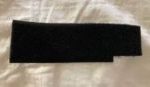
            • The first thing to do is trim the piece of Velcro to fit your receiver so it will be easy to put on, making sure that the serial number is visible and not covered up by the Velcro.
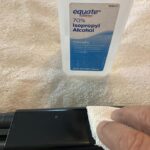
            • Then clean the receiver surface with alcohol to remove the dirt, oils, etc. that might cause the Velcro not to stick.
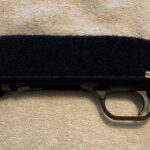
            • Once the alcohol is dry you can remove the clear backing and put the Velcro in place. Make sure you press all over the piece of Velcro so that the glue bonds to the receiver. (Leave it alone for a few hours so the glue sets well. It might be helpful to place a heavy book on top of the Velcro during those few hours).
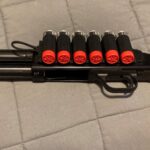
            • When the Velcro strip sets you are ready to place the shotgun card on your shotgun, I like to have the loop facing forward so I can pull it off in one clean motion after racking the slide, then replace it with a full one.
            Final Comments

            Making the decision to modify the forend of my Mossberg 500 worked out very well,  I was a bit nervous when I started but once I figured it all out things all came together perfectly. Do I wish I could have purchased a new style slide forend instead of trimming my old one, Maybe?  Only because there are so many new styles out there and it would have given my shotgun a new look and feel.   

            Would I do it again?  Absolutely!  I saved myself some money and did it all myself which is a big plus.  I also learned how to disassemble and reassemble a Mossberg 500 which is a good thing.  I really enjoy doing things myself and making things turn out well.  For anyone out there that may be in the same place as I was, I would recommend trimming your forend first.  If you like it then stay with it.  If not then you can always buy a new one later.

            As I said in the beginning, the subject matter of this article was a little outside the EDC parameters. But EDC is about being prepared for whatever comes along and being able to protect your family and yourself is about as important as it gets.  So if you choose to have a shotgun for home defense, then it must be set up in a way that works for the user and that is very important.  I chose to use a pump shotgun for home defense; therefore, this article was very relevant.

            If you have any questions about this post or anything related to Everyday Carry (EDC) or Concealed Carry, feel free to leave a comment below and I will be happy to get back to you.

            All the best,

            Larry

            Founder of Everyday Carry Essentials

              LEAVE A REPLY

              Your email address will not be published
              Required fields are indicated

              Gun Cleaning Kit, Buy One Or Make Your Own?

              Most people have an idea what a gun cleaning kit is, but not everyone has used one. Whether you were exposed to it from your grandfather, when he taught you how to shoot or your dad doing the same thing during your youth. If you shoot a gun, whether it is a handgun or a rifle, you need to clean it when you are done.  So a gun cleaning kit is what you use to clean your guns after you shoot them. But my question to you is do you buy one from a gun store or do you put your own together? Lets explore that question.

              Why Should You Clean Your Guns?

              In order to define a gun cleaning kit, you need to understand why you need one. Almost all bullets, centerfire and rimfire are made of a lead core with some type of copper jacket surrounding it. Even lead-free ammunition contains copper. When a bullet is fired, residue from the bullet components are left behind in the barrel, chamber, and action and that process is called “fouling.” The four most common types of fouling are:

              • Carbon, which occurs as a result of the burning powder that propels the bullet from the chamber through the barrel
              • Copper, caused by copper-jacketed bullets leaving residue in the gun’s barrel after firing
              • Lead, caused by lead bullets leaving residue in the gun’s barrel after firing
              • Plastic, caused by the plastic wads from shot shells

              It’s impossible to find ammunition that will not foul your gun. Black powder, most Berdan-primed, and a lot of military surplus ammunition is corrosive. This means there are salts in the ammo’s primer. These salts will damage your gun. If you shoot a gun using corrosive ammunition, you should clean it after each shooting session.

              If you neglect your guns and there are moisture issue where they are kept (gun cabinets, closets, under your bed, etc.), such as high humidity then rust can be a problem too. Rust can cause severe damage, becoming corrosive and eating through the metal. It is even possible that parts can rust together. Rust can also affect the rifling in the gun barrel, causing pits to occur thus permanent damage.

              Now that you understand how firing bullets and neglect of your firearms can leave residues that can damage your firearms, you should understand the need for a gun cleaning kit.  So a gun cleaning kit is made up of cleaning rods, swabs, patches, solvents and lubricants used to clean your guns in a way that removes all the dirt, oils and residues from your gun. Then it can be re-lubricated and ready for use.

              What Is In A Gun Cleaning Kit?

              Gun cleaning kits usually have many of the following items in the kit:
              • Cleaning rods – A cleaning rod is what will move the bore brush and cotton patches through the inside of your gun during the cleaning process. There are one-piece carbon fiber cleaning rods and ones made out of brass or aluminum. These metal rods are in screw together sections.
              • Bore brush – The inside of the barrel is called a bore and the brush used to clean the bore is a bore brush, they are caliber specific.
              • Cleaning Jags – Every cleaning kit will come with some type of jag to hold the patches in place on the end of the cleaning rod. There are a couple of different types – slotted and form-fitting.
              • Patches – Are usually made of cotton, round or square in shape.  
              • Gun oils and lubricants
              • Mops
              • Cleaning patches (caliber specific, lint and fiber-free)
              • Luster cloth/Silicone impregnated Gun and Reel Cloth
              • Disposable gloves
              • Double-ended/utility brushes
              • Cleaning swab (optional)
              • Bore snake (optional)
              • Cleaning chemicals, including bore cleaners, action cleaners, 
              • Disposable drip pan (to catch byproducts and residue of the cleaning process)(optional)
              • Gun cleaning mats (optional)

              There Are Many Gun Cleaning Kits Available.

              There are many gun cleaning kits on the market today and here are a few that work very well:
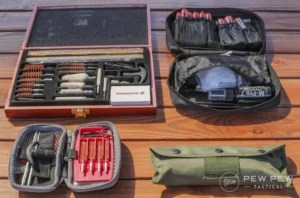
              • Guardtech  Gun Cleaning Kit -This kit comes with almost everything you’ll ever need for shotguns, pistols, rifles, and even rimfire. It also comes with stainless, brass, and nylon brushes that I use for getting the gunk off hard-to-clean surfaces. You will need to get some extra patches, cleaning solution, and gun oil and your cleaning kit will be complete.
              • M-Pro 7 Gun Cleaning Kit – This gun cleaning kit does have everything you need, including the oil and cleaner for your gun cleaning kit. The kit has individually packaged brushes and tips (.22 to 12-gauge) so you can keep everything organized and the case has more pouches to add additional cleaning items. It even comes with a silicone cloth to wipe down the surface of your guns. 
              • Winchester 32-piece Universal Gun Cleaning Kit

                This kit is a good deal for $30 since it is pretty universal…covering everything from .22 to 12 gauge shotgun. Two sets of brass rods won’t scratch your barrel’s harder steel and all the copper brushes are pretty good quality and marked with the caliber. It has a nice nylon case which keeps everything together. It comes with a small amount of patches, but you’ll need to add your own gun oil and gun cleaner to this kit.

              • Real Avid Gun Boss Handgun Cleaning Kit

                Now, do you only have a handgun right now, or want a super compact kit? The Real Avid kit is a great one for that. This kit covers everything from .22 to .45 caliber handguns. It’s tiny since the rods are long enough just for handgun-length barrels. It does not come with gun oil or cleaner…and you’ll be hard-pressed to fit anything in the box besides eye drop-sized droppers.

              • Gloryfire Universal Gun Cleaning Kit  – It’s small, slim, and has an empty bottle to put some cleaner or oil. This makes a good range kiy, if you are doing minimal cleaning. Can’t go wrong with a backup cleaning kit for around $10.
              • Hoppes Deluxe Gun Cleaning KitModel: 62108, This 62-piece cleaning kit contains everything you need to keep firearms spotlessly clean. Traditional Hoppe’s No. 9 Bore Cleaner, Lubricating Oil, and full-size brass rods and components keep pistols, rifles, and shotguns clean. All parts are contained in the durable, reusable locking tab carrying case.
              •  
              • Otis Tactical Cleaning System for Rifles, Pistols & Shotguns – For a little kit it is well-contained. It contains 100% cotton 2″ & 3″ patches (10 each), 3 slotted tips & 2 patch savers, Six firearm specific bronze bore brushes with size marked on brush stem (.22/.223, .270, .30/.308/30-06/30-30, .38/9mm, .45 cal, 12 ga),  8″ and 30″ aircraft grade Memory-Flex cables and thread connector for proper Breech-to-Muzzle cleaning. 34″ aircraft grade Memory-Flex cable (5-40 thread) with slotted tip is small enough to clean .17 caliber firearms,  Small & large obstruction removers knock out mud, snow & stuck casings. T-handle quickly attaches to the cable for added comfort. It also includes a chamber flag, 0.5 fl. oz. Shooter’s Choice FP-10 Lubricant Elite CLP & instruction manual and All items packed neatly in a 4″x4″x2.5″ soft pack case
               

              How Do You Make Your Own Gun Cleaning Kit?

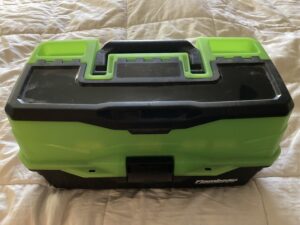
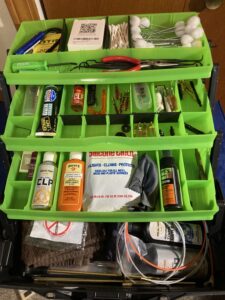
              This option would be for individuals who have been shooting for a while and are familiar with what is needed, not for the ones who are just getting started with firearms. If you decided to build your gun cleaning kit from scratch, you would first need a container to hold everything.  My favorite is a fishing tackle box with three shelves, they have plenty of dividers to keep all your items separate and organized. Once you have your container picked out then you need to customize your kit how you would like it. I have collected a lot of cleaning supplies through the years so making my own was very easy. I added brass cleaning rods, brass jags, cleaning patches,  cleaning brushes (nylon and brass), Q-tips, pipe cleaners, cotton swabs,  Hoppes #9 solvent squeeze bottle, Hoppes elite gun cleaner, Break Free CLP, and some wash clothes. I have recently added a Otis Tactical Gun Cleaning System and it works great. I also added a bore scope, a 1911 front lug wrench, some small screwdrivers, needle nose pliers, a pick set (plastic), and some silicone rags. This is very mobile kit but I usually just use it at home for good gun cleaning.  The newest addition to my cleaning kit is a Otis Tactical Gun Cleaning System, it has everything necessary to clean rifles, shotguns  and pistols. It gives me the tools to always clean from the breech to the muzzle and that is the best way to clean. I just purchased a one piece cleaning rod to be used on very stubborn gun cleaning situations, these will not scratch your bore or crown when cleaning.  I also added a smaller version of the Otis Cleaning System to my MB Sxowbmu Handgun Tactical Range Backpack (See the review on March 24,2022) for quick cleaning at the range.
              Final Comments

              My recommendation would be if you are just starting out using guns, buy yourself a medium-priced cleaning kit.  This will help you decide what you like and dislike, what is necessary for cleaning and lubrication, and what is only useless stuff (not necessary). Then you can modify your cleaning kit to fit your needs.  Some people like the commercial gun cleaning kits and never feel a need to make their own, and that’s OK.

              If you have been shooting for a while you may feel the need to make your own kit, and that’s fine too.  I hate the “junk” that some kits include in their kits, that’s what I call useless stuff.  So building your own gun cleaning kit is a way not to have that useless stuff and it only contains what you feel you need in a kit.

              I am leaning toward the Otis Tactical Gun Cleaning System in my gun cleaning kit.  I like the cables and they cannot scratch your barrel or crown and they do a very good job cleaning your guns, plus you can clean anything that you have. This method lets you use the chemicals to do the work instead of you scrubbing your barrel.

              So, the choice is yours, you do what you feel is right, there is no right or wrong answer.  I am here if you have questions; just leave a comment and I will answer your question.  Take care.

              If you have any questions about this post or anything related to Everyday Carry (EDC), feel free to leave a comment below and I will be happy to get back to you.

              All the best,

              Larry

              Founder of EDC Essentials

                LEAVE A REPLY

                Your email address will not be published
                Required fields are indicated

                Hammer & Punch or Sight Pusher, Which Do You Want To Use?

                Putting on new sights on your handgun can be a difficult job. Back when I first started shooting all we had was a hammer and brass punch.  While it got the job done it was a little difficult and the chances of marring your gun finish were substantial. Then came the sight pushers and that made this job a lot easier. 

                Using A Hammer And Punch

                When I first began shooting there was no other way to install new sights.  We all had brass punches that we used with a light hammer to install or adjust our sights.  We would cover our slides with a towel and put our slides in a vise, clamp them down and punch the sight in or out as we needed.  Doing things that way increased our chances of marring the guns finish.  

                Things To Watch Out For

                When doing this procedure, we needed to make sure we covered the slide very well so we did not scratch the slide when holding it in the vise and also during the punching process, we had to be careful not to scratch our gun with the punch as well.

                Using A Sight Pusher

                Then came the sight pushers! It was some time around 2014 that they came on the market and the good ones made your life much easier.  I say good ones because there were many on the market but they did not all work very well. If you wanted a good one then you had to pay for it. These good ones were over $100 and that was a lot of money for a tool that you only used a few times. 

                My first attempt at a sight pusher was to shop for price only and found a couple that was less than the higher priced ones, but unfortunately, they were garbage and did not work very well.  That was very frustrating to me and a lesson well learned, you get what you pay for.

                Using The VISM Universal Pistol Rear Sight Tool

                Then one day I was looking in the Glock Store and noticed the VISM Universal Pistol Rear Sight Tool and it looked pretty cool.  They had a video about it so I watched it, unfortunately I tried to post it but they removed it from Youtube..

                It got me intrigued, and it was only $59, so I bought one. That was the best money I spent in a long time.  What an excellent sight tool.  It made the task of installing new sights a breeze.  It took the frustration right out of the process.  This should work for many makes of handguns and it is so easy to work.  

                Final Remarks

                So what is the answer? Hammer & punch or a sight tool?  If you are talking about using the VISM Universal Pistol Rear Sight Tool then the answer is yes!  There are many on the market and not all of them work this easily. This tool is easy to operate and works very well and the chances of marring your gun’s finish is minimal, as long as you follow the instructions.  I highly recommend this tool and I think that anyone that changes their sights needs one of these.

                If you have any questions about this post or anything related to Everyday Carry (EDC)/Concealed Carry, feel free to leave a comment below and I will be happy to get back to you.

                All the best,

                Larry

                Founder of Everyday Carry Essentials

                  LEAVE A REPLY

                  Your email address will not be published
                  Required fields are indicated

                  How Do You Adjust A Kydex Holster or Kydex Knife Sheath?

                  If you are like me you like using Kydex material for your holsters or knife sheaths. It is weather-resistant and sweat resistant and holds its shape really well.  Plus there are many companies out there that will make them for you at a reasonable price.  Unfortunately, sometimes the holster or knife sheath is too tight and really rubs on your finish.  So at that point, you have two options: send it back to the manufacturer for an adjustment or do it yourself.  I used to send them back but that takes another couple of weeks before you will get it back and I found out it is really pretty simple to make the adjustments yourself.  So let’s explore the process to see if it is something you might want to try.

                  What Kind Of Tools Do I Need?

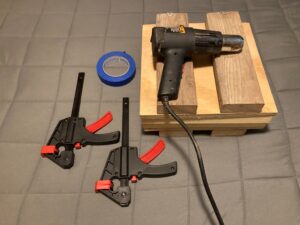
                  All you really need is a heat gun to soften the Kydex and your handgun or knife and you are in business. Because I am currently dealing with holsters at home, the rest of this article will focus on holsters.  But remember you can apply all this to knife sheaths too. The main thing is not to get in a hurry, take your time and it will work very easily. I take it a step further because I make my own knife sheaths, I use a Kydex press, some blue painter’s tape, two clamps to hold the press together, and the heat gun of course.  Now some people say you can use a hairdryer but I do not feel it gets quite hot enough and therefore it can get frustrating.  It is not in my picture but I like to also wear a pair of leather gloves to insulate your hands from the hot Kydex and decrease a chance of a burn.
                  What Should I Do First?

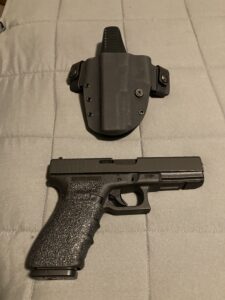
                  Here is the holster I am working on today, it is an awesome OWB holster that I love to wear but it is just a little tight around the slide.  I find if I do this to the holster, the finish on my handgun lasts much longer. Some people just use the heat gun to soften the Kydex, put your gun in the holster, and then systematically press on the holster in the areas that you want to change. I like to use blue painter’s tape in the areas that are tight, maybe two layers of tape to give just a little bit of clearance in those areas. Then you just can either put the holster in the Kydex press or just use hand pressure to conform the holster to the new desired contour of the holster.  The Kydex Press works great when making a holster from scratch but once it is made and has belt loops, etc. already there. Hand pressure works best and does not disturb the entire holster.
                  Step By Step Process:

                  Now that I talked about some different options, let’s go through it step by step:

                  1) Make certain your handgun is unloaded, check the magazine and chamber before you proceed with these instructions. (If you had bullets in your magazine or handgun, remove the ammo from the area you are working on so there is no chance that you can accidentally get a bullet in your handgun).

                  2) Place the handgun in the holster and see where it needs adjusting.

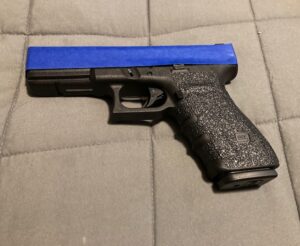
                  3) Place 2 or 3 layers of blue painter’s tape on your handgun in those areas, as seen in the picture to your right. Place your leather gloves on your hands.
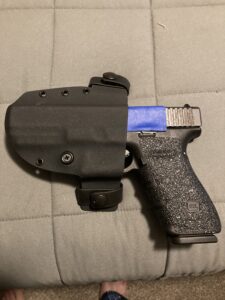
                  4) Begin heating up your holster by first placing the heat gun on high and warming it up, once warm switch to low and hear up the Kydex with the heat gun, always moving it from side to side, never keep it in one spot, that will burn the Kydex.

                  5) Once you feel the Kydex begin getting soft, turn the heat gun off and set it down on a non-flammable surface. Place the handgun in the softened holster and begin to push down with your thumbs.
                  6) When the Kydex has cooled and does not feel soft anymore,  you can pull your handgun out of the holster place your handgun back in the holster and see if it still feels tight. If it does repeat the above numbers #4 – 6.

                  How Do I Finish The Job?

                  When you feel it is adjusted correctly, remove the two layers of tape, wipe down the areas where you had tape to remove any stickiness that might be there. Then place your handgun in the holster and see how it fits.  If it does not drag and still clicks into place, you are done.  If it still drags then put two layers of tape back on and repeat # 4-6 again. After that, remove the tape, wipe down your handgun and check the holster again.  It should feel about right now.  Wipe your handgun down with a little Break Free CLP and put your gun back in your gun safe and you are done. This process takes a little time but it is worth it.

                  Final Comments

                  Well now you see how adjustments can be made in Kydex. Whether it is a holster, or a knife sheath, it can be done the same way.  You determine the number of pieces of tape that you use and that determines how much space you will have between the Kydex and your gun or knife.  And you can always start out with one piece of tape and see how that works and then increase as you need to.  But this process works great and the end result is awesome.  If you have any question, please comment below and I will get back to you as soon as I can.  Have a great day.

                  If you have any questions about this post or anything related to Everyday Carry (EDC)/Concealed Carry, feel free to leave a comment below and I will be happy to get back to you.

                  All the best,

                  Larry

                  Founder of Everyday Carry Essentials

                    LEAVE A REPLY

                    Your email address will not be published
                    Required fields are indicated

                    Upgrades To My Glock Handguns

                    Glock handguns have a worldwide reputation, some people like them and some do not. Yes, I am a Glock lover!  I feel there is not a better, more reliable handgun on the market today.  They are not the most beautiful handgun around, but if it does everything you need them to, that’s what you want.  I know that whenever I pull the trigger it will go “bang” and that’s what I want in a handgun. I have a Glock 26 (9mm), a Glock 30 (45ACP), and a Glock 20 (10mm), and I like every one of them.

                    When we begin to think about modifications of our Glocks, realize there are many products available on the market today. Just about anything you might like to do with your Glock, someone out there has it to buy. When I consider changing things on my Glocks, I think that Glock handguns are excellent handguns right from the factory and do not need all the fancy bells and whistles to make them better.  That being said there are a few small things that if upgraded will make your Glock handguns even better.  Let’s talk about those things that I think are important.

                    Extended Slide Stops

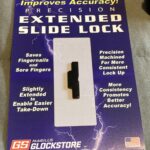
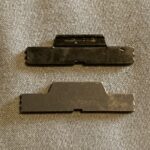
                    One thing that is necessary for all Glock is to clean your weapon after use. To do that it is necessary to field strip your Glock so you can get to the parts needed to be cleaned.  When you start this process you realize that the stock slide stop lever (takedown lever) that comes with your new Glock makes it very difficult to hold down that lever so you can remove the slide. Trying to dig your fingernails into that little bar can be very frustrating. Installing a new extended slide stop is a very easy and simple modification that you can do yourself instead of going to a gunsmith.  Installing this extended slide stop makes removing the slide so much easier.  As you can see by the picture, the original slide stop on top and the new extended slide stop on the bottom is not a lot different in size, only about 4mm different in length. But just that much longer makes the takedown process much easier.
                    New Sights

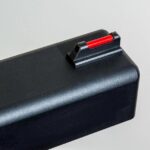
                    As much as I love my Glock handguns, there is one thing that definitely needs to be changed, and that is the sights.  I do not like their stock sights! I like either night sights or fiber-optic sights on my handgun.  The fact that they are plastic brings about the possibility that they can break and a broken sight renders the handgun almost useless.  
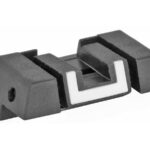
                    I found two possibilities that I will try, first there is a fiber optic front sight made by Pro Sight that really seems good and it is specially made for Glocks. I have a front sight like this on another handgun and I really like it.  Glock also makes an adjustable rear sight that I will try with the front fiber optic sight. It is nice to be able to have an adjustable rear sight so you can easily zero in your handgun.
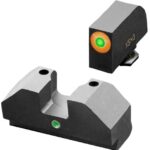
                    They were both very easy to install and give a really nice sight picture when using them.  I will shoot using these sights for a couple of months and at that time I should be able to see if I really like them.

                    If they will not work for me, I will try the XS SIGHTS F8 Night Sights. The reviews on them are really good and I have always wanted to try them out.   These are a little different in the fact that it is not a three-dot system.  There is only one dot in the front and one dot in the rear and you just line the dots up and shoot, they call it a figure eight. They too are made especially for Glocks and should be easy to install. So at least I have another option.
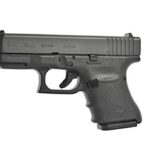
                    Pierce Grip Extensions

                    If you have a full-size Glock you will not need these grip extensions.  But if you have a compact or subcompact, they will really work out nice for you.
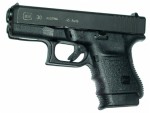
                    The picture on the top right shows a stock Glock 30 with a standard magazine plate that is flat.  As you can see there is only room for two fingers on the grip and that limits the handling of your firearm.  If you add a pierce grip extension to your magazines, like the Glock 30 in the middle picture or the bottom picture in the Glock 26, you can add another finger to your grip, thus making your grip more stable.
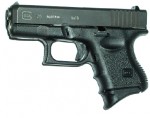
                    They have many styles of grip extensions that work for many different models, some may add additional 1 or 2 bullets to your magazine or it will not add bullets, just a place to rest your pinky finger. The Glock 30 (middle picture) holds one extra bullet, while the bottom picture shows my Glock 26 with the grip extension that only rests your pinky finger, with no extra bullets.  Whether you choose extra bullets or not, having a place for your pinky finger makes a big difference in control of your handgun and it looks pretty cool too.
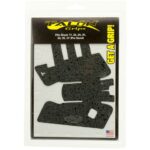
                    Adhesive Decal Grips

                    One other area that needs a little work is the grip texture.  The stock grip texture is OK but it really needs to be a bit rougher so it is easier to get a better purchase on the handgun, especially when shooting some heavy loads in a 10mm handgun.  Now I could send it to a company to re-texture the grip permanently, but that costs a few extra dollars and would be gone for a while.  

                    There are quite a few companies that have these decal grips but one that I really like is called Talon Grips. For about $20.00 and some personal labor, my handgun had better grip texture and is really pretty sweet. The package that you see comes with some great instructions, a pad with alcohol, and the pre-cut grips for your specific handgun.  If you order these, make certain that you order the correct one for your handgun, as there are many different shapes available.
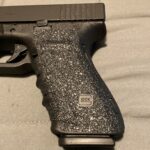
                    The first step is to wipe your grip down with the alcohol pad to remove any dirt or oils on the grip.  Then place the grip in the desired starting place and press down on the decal, pushing the air out as you go.  Once complete, use a heat gun or hairdryer to heat up the decal which makes it tighter and finishes the job.

                    Here is the link for a video on the installation process, it really helps, https://talongungrips.com/installation/

                    Less Mods Are Better

                    In the big scheme of things the modifications that I have discussed are not major.  But each one has its significance in making the handgun function better. Adding an extended slide stop decreases the frustration that occurs every time you clean your gun. Adding new sights helps your handgun be more accurate and therefore you are a better shot.  Adding Pierce Grip Extensions gives you a place for your pinky finger and therefore a better grip on your gun. And finally putting on Talon Grips adds more texture to your grip thus giving you better control of your handgun. If you put those all together, they add a definite increase to the actions of your handgun.  So I feel those modifications are well worth the time and effort. 

                    If you have any questions about this post or anything related to Everyday Carry (EDC)/Concealed Carry, feel free to leave a comment below and I will be happy to get back to you.

                    All the best,

                    Larry

                    Founder of Everyday Carry Essentials

                      LEAVE A REPLY

                      Your email address will not be published
                      Required fields are indicated

                      Lorem ipsum dolor sit amet, consectetur adipiscing elit. Ut elit tellus, luctus nec ullamcorper mattis, pulvinar dapibus leo.

                      Lorem ipsum dolor sit amet, consectetur adipiscing elit. Ut elit tellus, luctus nec ullamcorper mattis, pulvinar dapibus leo.